You can fix a punctured inflatable paddle board (iSUP) yourself using a specialized PVC patch kit and adhesive, typically requiring 24-48 hours for the glue to cure. This DIY repair involves locating the leak with soapy water, thoroughly cleaning and preparing the area, applying a PVC patch with appropriate cement, and allowing sufficient curing time to ensure a durable, waterproof seal. Most minor punctures are easily repairable at home, saving you money and extending your board’s lifespan.
Understanding Your Inflatable Paddle Board
Inflatable Stand-Up Paddle Boards (iSUPs) have revolutionized watersports with their portability and convenience. Constructed from layers of PVC with an internal drop-stitch core, they become remarkably rigid when inflated to their recommended pressure, typically between 12-15 PSI. This robust design makes them surprisingly resilient, but not entirely impervious to damage. Punctures often occur from sharp objects encountered on or near the water, such as rocks, shells, or even stray glass. Poor handling on land, like dragging the board over rough surfaces, can also lead to scrapes or small holes. Understanding these common culprits is the first step in effective repair and future prevention, reassuring you that most minor leaks are easily fixable at home.
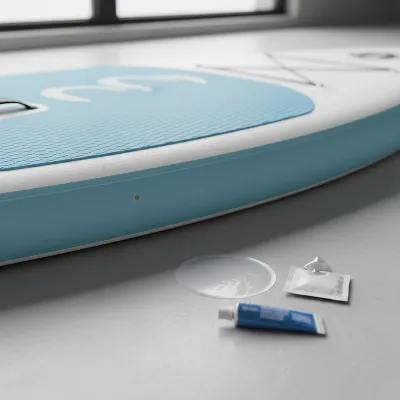 Overview of an inflatable paddle board with a small puncture, highlighting the PVC material and a repair kit nearby
Essential Tools and Materials for iSUP Repair
Before you embark on your repair mission, gathering the correct tools and materials is crucial for a successful and lasting fix. Most inflatable paddle boards come with a basic repair kit, which is an excellent starting point.
Here’s a checklist of what you’ll typically need:
- PVC Patch: Your repair kit usually includes color-matched patches. Ensure the patch is large enough to cover the puncture with at least a 1-2 inch overlap in all directions. For larger tears, a 3-inch overlap is recommended.
- Adhesive (PVC Cement): This is the most critical component. Do NOT use household glues like super glue, Gorilla Glue, or epoxy. You need a specialized PVC vinyl cement. Reputable brands include HH-66 Vinyl Cement, Stabond PVC Boat Adhesive, Clifton Urethane Adhesive, or Aquaseal FD Flexible Repair Adhesive. Always follow the specific instructions on your chosen adhesive.
- Cleaning Agents: Rubbing alcohol or acetone are excellent for preparing the surface by removing dirt, oils, and residues. MEK solvent is also highly effective but requires good ventilation and safety precautions.
- Pencil or Marker: For marking the puncture and outlining the patch.
- Masking Tape: Helps define the repair area and keeps excess glue contained.
- Roller or Blunt Object: A seam roller, the back of a spoon, or a smooth, rounded tool helps apply even pressure and remove air bubbles.
- 100-150 Grit Sandpaper (Optional but Recommended): Lightly scuffing the surface can improve adhesive bonding.
- Nitrile Gloves & Safety Glasses: Essential for protecting your hands and eyes from solvents and adhesives.
- Weight (Optional): A heavy object (10-20 lbs) can be placed on the patch during curing to ensure a strong bond.
- Spray Bottle with Soapy Water: Indispensable for leak detection.
- Valve Wrench: If your leak is at the valve, this tool (often included with your board) will be needed.
Step-by-Step Guide to Locating the Puncture
Finding a small leak in a large inflatable paddle board can feel like searching for a needle in a haystack, but with systematic steps, it’s quite manageable.
- Inflate to Pressure: Begin by fully inflating your iSUP to its recommended PSI (typically 12-15 PSI). This increases internal pressure, making any escaping air more noticeable.
- Listen and Feel: In a quiet environment, carefully listen for a distinct hissing sound around the board, paying close attention to seams, the valve area, and D-ring attachment points. You might also feel a subtle draft of air with your hand if the puncture is larger.
- The Soapy Water Test: This is the most reliable method. Mix a generous amount of dish soap with water in a spray bottle – the more suds, the better. Liberally spray the soapy solution over suspect areas of your inflated board. Watch closely: air escaping from a puncture will create telltale bubbles that grow and burst. Work methodically across the entire surface of the board, including the top, bottom, rails, and around all accessories.
- Check the Valve: Often, a leak isn’t a puncture but simply a loose valve. If you find bubbles around the valve, use your valve wrench to tighten it. Re-test with soapy water. If bubbles persist after tightening, you might need to replace the O-ring or, in rare cases, the entire valve.
- Mark the Spot: Once you identify the leak, use a pencil or waterproof marker to clearly circle the exact spot. This prevents losing track of it once the board is deflated.
Preparing Your Paddle Board for Patching
Proper preparation is the bedrock of a successful repair. Skimping on these steps can lead to a patch that fails prematurely.
- Completely Deflate the Board: Ensure all air is out of your iSUP. A fully deflated board allows the patch to adhere smoothly without internal pressure interfering.
- Clean the Area Thoroughly: Using rubbing alcohol or acetone, meticulously clean the marked puncture area and a surrounding margin significantly larger than your intended patch. This removes dirt, grease, sunscreen residues, and any factory coatings that could hinder adhesion. Let the area dry completely before proceeding. A truly clean surface is paramount for the glue to bond effectively.
- Lightly Scuff (Optional but Recommended): For enhanced adhesion, you can gently scuff the cleaned area with fine-grit sandpaper (100-150 grit). This creates a slightly textured surface, providing more grip for the adhesive. Be careful not to scuff too aggressively, which could damage the PVC. Clean away any sanding dust afterwards.
- Cut the Patch: Round the corners of your chosen PVC patch. Patches with sharp corners are more prone to peeling over time. Ensure the patch is large enough to extend at least 1-2 inches beyond the puncture in all directions.
- Outline the Patch: Place the cut patch over the puncture and use a pencil to lightly trace its outline onto the board. This guide will ensure precise placement.
- Apply Masking Tape: For a clean finish and to prevent excess glue from spreading, apply masking tape around the pencil outline, leaving just enough space for your adhesive application.
“A small, well-executed repair can extend the life of your inflatable paddle board by years. The key is patience and meticulous attention to cleaning and curing times.” – Sarah Chen, Certified iSUP Repair Technician
Applying the Patch for a Durable Fix
Now that your board is prepped, it’s time for the critical step: applying the patch. Always work in a well-ventilated area and wear gloves and safety glasses, as adhesives and solvents can be strong.
- Read Adhesive Instructions: Different PVC cements have varying application and drying times. Always refer to the specific instructions provided with your adhesive or repair kit.
- Apply Adhesive:
- Single Coat (for some glues): Apply a thin, even layer of adhesive to both the back (matte side) of the patch and the outlined area on your deflated board.
- Multiple Coats (for others, like two-part adhesives): Some adhesives require two or three thin coats on both surfaces, with a brief drying time (e.g., 5-10 minutes) between each coat, until the glue becomes tacky but not fully dry. The goal is a consistent, thin layer.
- Position the Patch: Carefully align the patch with your pencil outline on the board. Once the patch makes contact, it’s often difficult to reposition, so aim for accuracy on your first attempt.
- Press and Remove Air Bubbles: Once the patch is in place, immediately use a roller, spoon, or blunt object to firmly and evenly press the patch onto the board. Work from the center of the patch outwards towards the edges, pushing out any trapped air bubbles. This ensures a strong, uniform bond.
- Remove Masking Tape: If you used masking tape, remove it immediately after pressing the patch, while the glue is still wet, to avoid tearing the patch or leaving adhesive residue once dry.
- Clean Excess Glue: Carefully wipe away any excess adhesive that seeped out from under the patch using a clean cloth and a small amount of the cleaning agent (rubbing alcohol or acetone), if permitted by the glue manufacturer.
- Cure Time: This is perhaps the most overlooked but crucial step. Allow the glue to cure completely. Most manufacturers recommend a minimum of 24 hours, with some suggesting 36-48 hours for optimal bonding, especially for areas under high stress. During this time, avoid inflating or disturbing the patched area. Placing a heavy object (10-20 lbs) on the patch during the initial curing can help ensure a strong, flat bond.
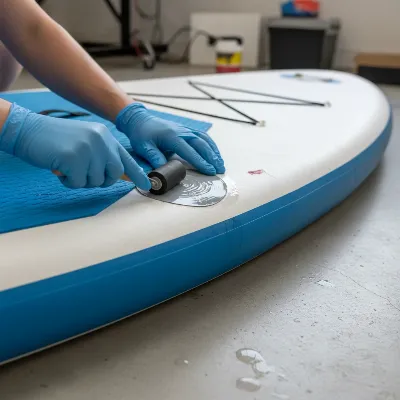 Detailed view of hands applying a patch to an inflatable paddle board, showing the process of removing air bubbles
Post-Repair Care and Prevention
Once your patch has fully cured, your inflatable paddle board should be ready for action. However, a little post-repair care and preventive maintenance can significantly extend its lifespan and prevent future punctures.
- Re-inflate and Re-test: After the recommended curing time, slowly inflate your paddle board to its usual pressure. Then, perform another soapy water test over the patched area to confirm there are no remaining leaks. If bubbles appear, you may need to re-evaluate the repair or add another layer of adhesive.
- Proper Storage: When not in use, always clean and thoroughly dry your iSUP. Store it deflated and rolled up in its bag in a cool, dry place away from direct sunlight and extreme temperatures. UV rays and excessive heat can degrade PVC and adhesives over time. If storing inflated, reduce the pressure slightly.
- Mindful Handling: Avoid dragging your board over rough surfaces like asphalt, concrete, or rocky ground. Always carry it or use a wheeled cart. Be cautious when launching and landing, inspecting the area for sharp objects.
- Protective Gear: Consider using a fin guard if paddling in shallow areas, and always check your surroundings for potential hazards.
Conclusion
A punctured inflatable paddle board doesn’t have to signal the end of your aquatic adventures. With a systematic approach, the right materials, and a bit of patience, you can confidently repair most punctures yourself. From meticulously locating the leak with the soapy water test to carefully applying a specialized PVC patch, each step plays a vital role in ensuring a durable and long-lasting fix. By embracing these DIY repair techniques and practicing good board maintenance, you’ll not only save money but also gain the satisfaction of keeping your beloved iSUP adventure-ready. So, next time you face a deflated moment, remember these steps, patch it up, and get ready to paddle on!
What’s the most challenging part of maintaining your inflatable paddle board?
Frequently Asked Questions
Can I use super glue or Gorilla Glue to fix my inflatable paddle board?
|
Our Picks for the Best Paddle Board in 2026
As an Amazon Associate I earn from qualifying purchases.
|
||
| Num | Product | Action |
|---|---|---|
| 1 | FunWater Inflatable Stand Up Paddle Board with Premium SUP Paddleboard Accessories, Anti-Slip EVA Deck, 11'/10'6'' Paddle Boards for Adults & Youth of All Skill Levels |

|
| 2 | Niphean Inflatable Stand Up Paddle Board with SUP Accessories, Anti-Slip EVA Deck, 10’6’’ Inflatable Paddle Boards for Adults & Youth of All Skill Levels |
|
| 3 | Retrospec June Nano Kids Inflatable Fishing Paddle Board SUP Kayak: 9'6" Hybrid Paddleboard with Rod Holders, Removable Seat - Lightweight Portable Youth Fishing Board |
|
| 4 | Roc Inflatable Stand Up Paddle Boards with Premium SUP Paddle Board Accessories, Wide Stable Design, Non-Slip Comfort Deck for Youth & Adults |
|
| 5 | FBSPORT 11' Premium Stand Up Paddle Board, Yoga Board with SUP Accessories & Carry Bag | Wide Stance, Surf Control, Non-Slip Deck, Leash, Paddle and Pump for Youth & Adult |
|
| 6 | Roc Inflatable Stand Up Paddle Board 10' 6" with Premium SUP Paddle Board Accessories, Wide Stable Design, Non-Slip Comfort Deck for Youth & Adults |
|
| 7 | FunWater Inflatable Stand Up Paddle Board with Premium SUP Paddleboard Accessories, Anti-Slip EVA Deck, 11'/10'6'' Paddle Boards for Adults & Youth of All Skill Levels |
|
| 8 | Roc Inflatable Stand Up Paddle Board 10' 6" with Premium SUP Paddle Board Accessories, Wide Stable Design, Non-Slip Comfort Deck for Youth & Adults |
|
| 9 | Roc Inflatable Stand Up Paddle Board 10' 6" with Premium SUP Paddle Board Accessories, Wide Stable Design, Non-Slip Comfort Deck for Youth & Adults |
|
| 10 | Highpi Inflatable Stand Up Paddle Board for Youth and Adults – Wide Sup with Premium Accessories, Blow Up Paddleboard for Surfing, Fishing, Yoga & More |
|
No, you should never use super glue, Gorilla Glue, or similar all-purpose adhesives for inflatable paddle board repairs. These glues are typically rigid and will not create a flexible, durable, and waterproof bond with the PVC material of your iSUP, often leading to repair failure. Always use specialized PVC vinyl cement.
How long does an inflatable paddle board patch need to dry?
Most repair adhesives for inflatable paddle boards require a minimum of 24 hours to fully cure. For optimal bonding, especially in high-pressure areas or with certain glues, it’s often recommended to wait 36 to 48 hours before reinflating the board. Always follow the specific instructions on your adhesive’s packaging.
What if the leak is at the board’s valve?
If you suspect a valve leak, first try tightening it with the valve wrench that came with your board. Apply soapy water to check if the bubbles stop. If tightening doesn’t work, the O-ring inside the valve might be worn and needs replacing. In rare cases, the entire valve assembly may need professional attention.
Can I repair a large tear or seam separation myself?
Small punctures and minor tears (up to a few inches) are generally repairable DIY. However, large tears, particularly those exceeding several inches, or significant seam separations, can be challenging and often require professional repair. Attempting to fix extensive damage yourself might compromise the board’s integrity. For temporary field repairs, Tear-Aid Type B tape can offer a quick solution.
Frequently Asked Questions
Can household glues like super glue fix an inflatable paddle board puncture?
No, you should never use household glues such as super glue or Gorilla Glue for inflatable paddle board repairs. These glues are rigid and will not form a flexible, durable, and waterproof bond with the iSUP's PVC material, leading to repair failure. Always use specialized PVC vinyl cement for effective repairs.
What is the recommended drying time for an inflatable paddle board patch?
Most repair adhesives for inflatable paddle boards require a minimum of 24 hours to fully cure. For optimal bonding, especially in high-pressure areas, it is often recommended to wait 36 to 48 hours before reinflating the board. Always follow the specific instructions provided with your chosen adhesive.
How do I fix a leak if it's coming from the paddle board's valve?
If you suspect a valve leak, first try tightening it with the valve wrench that came with your board. Apply soapy water to the valve area to check for bubbles. If tightening doesn't stop the bubbles, the O-ring inside the valve might be worn and needs replacement. In rare cases, the entire valve assembly may require professional attention.
Are large tears or seam separations on an iSUP repairable at home?
Small punctures and minor tears, typically up to a few inches, are generally repairable DIY. However, large tears exceeding several inches or significant seam separations are challenging and often require professional repair to maintain the board's integrity. For temporary field repairs, Tear-Aid Type B tape can offer a quick solution.
What tools are essential for a successful inflatable paddle board repair?
Essential tools for an iSUP repair include a PVC patch, specialized PVC vinyl cement, cleaning agents like rubbing alcohol or acetone, a pencil or marker, masking tape, and a roller or blunt object to press the patch. Optional but recommended items are 100-150 grit sandpaper, nitrile gloves, safety glasses, and a spray bottle with soapy water for leak detection.
How to Fix a Punctured Inflatable Paddle Board
This guide provides a step-by-step process for locating a puncture and applying a durable patch to your inflatable paddle board.
Inflate your iSUP to its recommended PSI (12-15 PSI). Use a spray bottle with soapy water to liberally coat suspect areas; escaping air will create visible bubbles. Mark the exact spot with a pencil or waterproof marker once identified.
Completely deflate the board. Clean the marked puncture area and a surrounding margin (larger than your patch) thoroughly with rubbing alcohol or acetone to remove dirt and oils. Lightly scuff the cleaned area with 100-150 grit sandpaper for better adhesion, then clean away any dust.
Cut your PVC patch with rounded corners, ensuring it extends 1-2 inches beyond the puncture in all directions. Place the patch over the puncture and lightly trace its outline onto the board. Apply masking tape around this outline to contain excess glue.
Read your PVC cement instructions carefully. Apply a thin, even layer of adhesive to both the back of the patch and the outlined area on the board. Carefully align and position the patch, then firmly press it from the center outwards with a roller or blunt object to remove air bubbles. Remove masking tape immediately.
Allow the glue to cure completely for a minimum of 24 hours, with 36-48 hours recommended for optimal bonding, especially in high-stress areas. Avoid inflating or disturbing the patched area during this time. After curing, slowly re-inflate and perform a soapy water test over the patch to confirm no remaining leaks.

The instructions were clear for the most part, especially about using a specialized PVC patch kit. However, I struggled a bit with getting the adhesive spread evenly without making a mess. Maybe a tip on how much glue to use for different size punctures would be helpful. My repair seems to be holding, but it wasn’t as ‘easy’ as I hoped, and I had to re-read the curing time section a few times to make sure I got it right.
I was so bummed when I found a small puncture on my iSUP after a rocky launch. This guide was a lifesaver! I followed the steps for locating the leak with soapy water and it worked perfectly. The PVC patch kit I ordered online, combined with these instructions, made the repair super straightforward. My board is holding air like new, and I saved a ton of money not having to take it to a shop.
Good tips here for fixing a punctured paddle board. I had a tiny pinhole from a stray branch and was worried it was toast. The advice about cleaning and preparing the area thoroughly before applying the patch really made a difference. I did find that the 24-hour curing time felt a bit long, especially when I was eager to get back on the water, but it was worth the wait for a solid seal.
This is exactly what I needed! My board had a small tear near the fin box, and I thought I’d have to buy a new one. The explanation of how iSUPs are constructed from PVC layers gave me confidence that a DIY fix was possible. I followed the steps for applying the patch and letting it cure for the full 48 hours, and it’s completely sealed. So happy to extend the life of my board!