Attaching a kayak seat to your paddle board transforms it into a versatile sit-down kayak hybrid, enhancing comfort and stability for longer excursions or windy conditions. This DIY modification allows you to rest your legs, enjoy greater stability, and extend your time on the water, effectively turning your existing SUP into a multi-functional craft for diverse paddling adventures.
What is a Paddle Board Kayak Conversion?
A paddle board kayak conversion involves equipping your standard SUP with a detachable seat and often a double-bladed paddle, effectively transforming it into a sit-on-top kayak. This hybrid setup merges the portability and surface area of a paddle board with the seated comfort and efficiency of a kayak. It’s a fantastic way to diversify your paddling adventures without investing in a completely separate vessel.
The benefits of converting your SUP are numerous, extending its utility for various paddlers and conditions. For beginners, sitting down lowers your center of gravity, significantly enhancing stability and making it easier to learn and maneuver. On longer trips, a kayak seat reduces fatigue on your legs and back, allowing you to paddle further and for extended periods in greater comfort. If you’re an angler, the seated position provides a more stable platform for fishing, freeing your hands and giving you better leverage when reeling in a catch. In windy or choppy waters, paddling while seated offers increased control and stability, helping you navigate challenging conditions more effectively. This conversion essentially makes paddle boarding accessible to a wider audience, including those who may have balance issues or prefer a less strenuous activity.
Essential Gear for Your SUP Kayak Setup
To successfully attach a kayak seat to your paddle board, you’ll need a few key components. Having the right gear ensures a secure fit and a comfortable paddling experience.
First and foremost is a detachable kayak seat. These seats are specifically designed for paddle board conversions, featuring padded backrests and adjustable straps that typically clip onto D-rings on your board. Look for models that offer good lumbar support and durable, marine-grade materials that can withstand water exposure.
The most critical attachment points are D-rings on your SUP. Many modern inflatable paddle boards (iSUPs) come equipped with 4 to 6 pre-installed D-rings, strategically placed for accessories like kayak seats. These rings are usually located two near the front and two near the back of the deck pad. If your paddle board doesn’t have D-rings, don’t worry! You can purchase adhesive D-ring kits designed for inflatable boards. These kits typically include marine-grade PVC D-ring patches and a strong adhesive, allowing for a robust DIY installation.
While not strictly required for attaching the seat, a convertible paddle is highly recommended to maximize your kayak experience. Many SUP paddles are designed with a removable T-bar handle that can be swapped for a second paddle blade, transforming it into a dual-bladed kayak paddle. This allows for more efficient paddling from a seated position, as you can stroke on both sides of your board without constantly switching hands.
Finally, if you need to install D-rings, you’ll also need some cleaning supplies (like rubbing alcohol or acetone) to prepare the surface of your board, and the marine-grade adhesive that usually comes with D-ring kits.
Step-by-Step Guide: Attaching Your Kayak Seat
Converting your paddle board into a kayak is a straightforward process, especially if your board already has D-rings. Even without them, the DIY installation is manageable.
Prepare Your Paddle Board
|
Our Picks for the Best Paddle Board in 2026
As an Amazon Associate I earn from qualifying purchases.
|
||
| Num | Product | Action |
|---|---|---|
| 1 | FunWater Inflatable Stand Up Paddle Board with Premium SUP Paddleboard Accessories, Anti-Slip EVA Deck, 11'/10'6'' Paddle Boards for Adults & Youth of All Skill Levels |

|
| 2 | Roc Inflatable Stand Up Paddle Boards with Premium SUP Paddle Board Accessories, Wide Stable Design, Non-Slip Comfort Deck for Youth & Adults |
|
| 3 | Roc Inflatable Stand Up Paddle Board 10' 6" with Premium SUP Paddle Board Accessories, Wide Stable Design, Non-Slip Comfort Deck for Youth & Adults |
|
| 4 | FunWater Inflatable Stand Up Paddle Board with Premium SUP Paddleboard Accessories, Anti-Slip EVA Deck, 11'/10'6'' Paddle Boards for Adults & Youth of All Skill Levels |
|
| 5 | Highpi Inflatable Stand Up Paddle Board for Youth and Adults – Wide Sup with Premium Accessories, Blow Up Paddleboard for Surfing, Fishing, Yoga & More |
|
| 6 | Niphean Inflatable Stand Up Paddle Board with SUP Accessories, Anti-Slip EVA Deck, 10’6’’ Inflatable Paddle Boards for Adults & Youth of All Skill Levels |
|
| 7 | Roc Inflatable Stand Up Paddle Board 10' 6" with Premium SUP Paddle Board Accessories, Wide Stable Design, Non-Slip Comfort Deck for Youth & Adults |
|
| 8 | Retrospec June Nano Kids Inflatable Fishing Paddle Board SUP Kayak: 9'6" Hybrid Paddleboard with Rod Holders, Removable Seat - Lightweight Portable Youth Fishing Board |
|
| 9 | FBSPORT 11' Premium Stand Up Paddle Board, Yoga Board with SUP Accessories & Carry Bag | Wide Stance, Surf Control, Non-Slip Deck, Leash, Paddle and Pump for Youth & Adult |
|
| 10 | Roc Inflatable Stand Up Paddle Board 10' 6" with Premium SUP Paddle Board Accessories, Wide Stable Design, Non-Slip Comfort Deck for Youth & Adults |
|
Before you begin, ensure your paddle board is ready. If you have an inflatable SUP, fully inflate it to its recommended PSI. Lay your board on a clean, flat, and dry surface to prevent damage or dirt adhesion during the setup. This also provides a stable platform for attaching the seat.
Next, locate the existing D-rings on your paddle board. Most boards designed for kayak conversion will have four D-rings – two positioned towards the front (nose) of the board and two towards the back (tail), near the deck pad. These are the anchor points for your kayak seat straps.
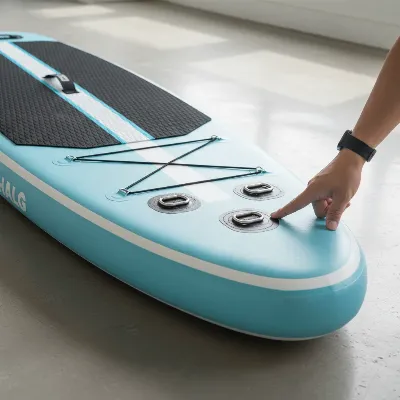 Locating D-rings on an inflated paddle board deck for kayak seat attachment
Installing D-Rings (If Needed)
If your paddle board lacks pre-installed D-rings, you’ll need to add them. This DIY step is crucial for securing your kayak seat safely.
- Determine Placement: Choose a comfortable and balanced position for your seat, typically slightly back from the board’s center, around where you’d usually sit or kneel. Mark the spots for your D-rings—you’ll need four, forming a rectangle for the seat straps. Ensure they are evenly spaced to properly tension the seat.
- Clean the Surface: Thoroughly clean the marked areas on your board where the D-rings will be attached. Use rubbing alcohol or acetone to remove any dirt, wax, or residue, as a clean surface is essential for a strong adhesive bond. Allow the area to dry completely.
- Apply Adhesive: Apply a marine-grade PVC adhesive (often included with D-ring kits) to the back of each D-ring patch and the corresponding cleaned area on your board. Follow the adhesive manufacturer’s instructions precisely regarding application, drying time, and any multi-coat requirements.
- Attach D-Rings: Carefully press each D-ring patch firmly onto the marked spots on your board. Smooth out any air bubbles from under the patch, working from the center outwards.
- Cure Fully: Allow the adhesive to cure completely. This is perhaps the most critical step; do not rush it. Curing times can vary, so consult the adhesive instructions, which might recommend several hours or even a full day for maximum bond strength.
Positioning and Securing the Seat
Once your D-rings are ready (either pre-installed or newly attached), it’s time to set up your kayak seat.
- Position the Seat: Place the kayak seat on the deck pad of your paddle board, facing forward, ideally around the board’s center or slightly behind the handle.
- Loosen Straps: Fully loosen all the adjustable straps on your kayak seat. This provides maximum slack for easy attachment to the D-rings.
- Attach Rear Straps: Start with the back straps of the kayak seat. Clip or hook them to the two D-rings located towards the tail of your board.
- Attach Front Straps: Next, attach the front straps of the kayak seat to the two D-rings located towards the nose of your board.
- Adjust for Tension and Comfort: With all straps attached, begin to tighten them. Start with the rear straps to create an upright tension for the backrest. Then, tighten the front straps, ensuring the seat is firm and secure but not overly tensioned. Aim for a comfortable backrest angle and a snug fit that prevents the seat from shifting during use. The goal is to feel stable and supported.
Final Adjustments and Safety Check
Before you hit the water, perform a final check and make any necessary adjustments.
Sit on the board with the attached seat to test its stability and comfort. Adjust the straps further until you find your optimal seating position and back support. It’s often helpful to make minor adjustments while on the water during your first few paddles, as you’ll get a better feel for what works best.
If you’re using a convertible paddle, now is the time to adjust its length for kayaking mode. Generally, kayak paddles are shorter than SUP paddles.
Always prioritize safety. Before every outing, double-check that the kayak seat is firmly attached to your paddle board. For your first few times using the converted SUP, start slowly to get accustomed to the new setup and the feel of paddling while seated.
Choosing the Right Kayak Seat for Your SUP
Selecting the ideal kayak seat is paramount for comfort and performance when converting your paddle board. Not all kayak seats are created equal, and some are better suited for SUP conversions than others.
First, compatibility is key. Ensure the kayak conversion seat you choose is designed to work with paddle boards and has adjustable straps that can fit various board sizes. Most quality SUP kayak seats will feature straps with clips or carabiners specifically for attaching to D-rings.
Comfort features should be a top priority. Look for seats with ample padding in both the seat base and the backrest. Good lumbar support is crucial, especially for longer paddling sessions, to prevent back strain. Some seats may also offer additional features like mesh storage pockets or integrated fishing rod holders, enhancing the overall experience.
Finally, strap adjustability is vital for a personalized fit. The straps should be easily adjustable, allowing you to fine-tune the tension and angle of the backrest to achieve maximum comfort and stability for your body type and paddling style. The ability to adjust straps quickly, even while on the water, can make a significant difference in your paddling enjoyment.
Maximizing Your Paddle Board Kayak Experience
Converting your SUP to a kayak hybrid opens up new possibilities. To make the most of this versatile setup, consider a few tips and additional accessories.
When paddling while seated, your center of gravity is lower, offering increased stability. This can be particularly advantageous in windy conditions or choppy waters, where a seated position provides better control and allows you to power through with a double-bladed paddle more effectively. It’s also an excellent option for exploring sheltered coves, calm lakes, or winding rivers where a relaxed pace is desired.
Consider incorporating a leash for your paddle if you haven’t already. While essential for standing paddle boarding, it becomes even more useful in kayak mode to prevent your paddle from drifting away if you momentarily let go. A personal flotation device (PFD) is always recommended, regardless of your paddling style or experience level, for safety on the water. For those planning longer trips, a waterproof dry bag can keep essentials like snacks, extra layers, and electronics safe and dry, easily secured to your board’s bungee cords or D-rings.
“The beauty of the SUP-kayak hybrid lies in its adaptability. You’re not just buying a board; you’re investing in a multi-sport platform that caters to your evolving needs on the water.” – Jane Doe, Paddle Sports Enthusiast & Instructor
Maintaining Your SUP and Kayak Seat
Proper maintenance of both your paddle board and kayak seat will ensure their longevity and performance for many seasons of enjoyment.
After each use, especially if paddling in saltwater, it’s crucial to rinse both your paddle board and kayak seat with fresh water. This removes salt, sand, and other debris that can degrade materials over time. Use a mild soap if needed, and gently scrub away any stubborn dirt or grime. Pay close attention to the D-rings and strap buckles, as salt can cause corrosion.
Allow both the board and the seat to dry completely before storing them. Storing wet gear can lead to mildew, unpleasant odors, and material damage. For inflatable SUPs, ensure they are thoroughly dry before deflating and rolling them up.
When it comes to storage, keep your paddle board and kayak seat in a cool, dry place away from direct sunlight and extreme temperatures. UV rays can weaken materials and fade colors over time. If storing your inflatable SUP deflated, try to roll it loosely to avoid sharp creases. Store the kayak seat detached from the board, ideally in a breathable bag, to prevent any pressure points from forming and to maintain its shape. Regularly inspect the straps, buckles, and D-rings for any signs of wear, tear, or damage, and replace components as needed.
Conclusion
Converting your paddle board into a kayak hybrid is a fantastic way to unlock new levels of comfort, versatility, and stability on the water. Whether you’re a seasoned paddler looking to extend your adventures or a beginner seeking a more stable learning platform, attaching a kayak seat to your SUP is a DIY project that delivers significant rewards. By following our step-by-step guide, gathering the right gear—including a detachable kayak seat, D-rings, and a convertible paddle—and performing regular maintenance, you can effortlessly improve your board. Embrace the freedom of choice that this simple modification offers, allowing you to sit back, relax, and explore the waterways with renewed enjoyment. So, are you ready to experience the best of both paddling worlds?
Frequently Asked Questions
Frequently Asked Questions
Can I use any kayak seat for my paddle board conversion?
While many universal kayak seats can work, it is best to choose a detachable kayak seat specifically designed for SUP conversion. These seats typically feature adjustable straps and attachment clips compatible with the D-rings found on most paddle boards, ensuring a secure and comfortable fit.
How long does it take to install D-rings on an inflatable paddle board?
The physical attachment of adhesive D-rings is relatively quick, usually taking less than an hour. However, the most time-consuming part is allowing the marine-grade adhesive to fully cure, which can take anywhere from 12 to 24 hours or even longer, depending on the specific adhesive used, to ensure a strong and lasting bond.
Is it stable to paddle a SUP with a kayak seat attached?
Yes, paddling a SUP with a kayak seat can actually enhance stability. By sitting down, you lower your center of gravity, which makes the board feel more stable, especially beneficial in choppy conditions or for new paddlers. This setup provides increased control compared to standing.
What kind of paddle is best for a paddle board with a kayak seat?
While you can use a standard SUP paddle, a convertible paddle is highly recommended for a paddle board with a kayak seat. These paddles allow you to remove the T-bar handle and attach a second blade, effectively creating a double-bladed kayak paddle for more efficient propulsion from a seated position.
What are the main benefits of converting a paddle board to a kayak?
Converting a paddle board to a kayak offers several benefits, including enhanced stability for beginners, reduced fatigue on longer trips, a more stable platform for fishing, and increased control in windy or choppy waters. This versatility allows for a wider range of paddling experiences.
How to Attach a Kayak Seat to Your Paddle Board
This guide provides step-by-step instructions for attaching a kayak seat to your paddle board, including D-ring installation if needed, to convert your SUP into a versatile kayak hybrid.
Fully inflate your inflatable SUP to its recommended PSI and lay it on a clean, flat, and dry surface. Locate the existing D-rings on your board, typically four rings positioned towards the front and back of the deck pad, which will serve as anchor points for the seat straps.
If your board lacks D-rings, determine comfortable placement for four rings, clean the surface with rubbing alcohol, apply marine-grade PVC adhesive to the D-ring patches and board, and press the patches firmly. Allow the adhesive to cure completely for 12-24 hours as per manufacturer instructions for maximum bond strength.
Place the kayak seat on the deck pad, facing forward, around the board's center. Loosen all adjustable straps on the seat, then attach the rear straps to the D-rings towards the tail and the front straps to the D-rings towards the nose. Begin tightening the rear straps to create backrest tension, then tighten the front straps for a firm, secure fit.
With all straps attached, adjust them to achieve a comfortable backrest angle and a snug fit that prevents the seat from shifting during use. The goal is to feel stable and supported. Sit on the board to test stability and make further adjustments until you find your optimal seating position.
Before hitting the water, perform a final check to ensure the kayak seat is firmly attached. Adjust your convertible paddle length for kayaking mode, as kayak paddles are generally shorter than SUP paddles. Always prioritize safety by double-checking attachments and starting slowly during your first few paddles with the converted SUP.

This DIY conversion is a game-changer for windy days. I always struggled with stability when the wind picked up, but being able to sit down with the kayak seat makes it so much more manageable. The tip about using a double-bladed paddle was also spot on – it really helps with efficiency. Definitely recommend giving this a try if you want more versatility from your SUP.
I’ve been wanting to try this for ages! The guide on attaching a kayak seat was super clear and easy to follow. I used my existing D-rings and some straps I already had, and it worked perfectly. It really does make a huge difference for those longer paddles when my legs start to get tired. So glad I finally did it!
The instructions for attaching the seat were pretty good, but I found that my particular inflatable board’s D-ring placement wasn’t ideal for the seat I had. It still works, but it’s not as snug as I’d hoped. I might need to invest in a different seat or try to add more attachment points. It’s definitely more comfortable for resting, though.
I was skeptical about turning my SUP into a kayak hybrid, but this guide convinced me to try it. The enhanced comfort for longer excursions is exactly what I needed. It’s like having two boards in one without buying a whole new vessel. My back thanks you!