The serenity of gliding across the water on your inflatable paddle board is an unmatched experience, offering both peace and exhilarating adventure. However, few things disrupt this tranquility faster than discovering your board is losing air. Whether it’s a slow leak that subtly deflates your day or a more apparent hiss, a leaky inflatable stand-up paddle board (iSUP) can be frustrating. But don’t let a minor setback deflate your enthusiasm; most leaks are fixable. This comprehensive guide will help you understand why your iSUP might be leaking, how to find the problem, and step-by-step instructions to get you back on the water with confidence.
What Causes Your Inflatable Paddle Board to Leak Air?
Identifying the root cause of air loss is the first step toward a successful repair. Several factors can contribute to an inflatable paddle board losing pressure, ranging from normal material behavior to accidental damage. Understanding these common culprits helps diagnose the issue accurately.
Firstly, it’s essential to distinguish between a genuine leak and normal air pressure changes. All inflatable boards experience slight air loss over time due to temperature shifts, which cause air to expand or contract, and micro-permeation through the material. A minor drop in PSI over several days, especially with temperature fluctuations, is often normal.
However, more significant or rapid air loss usually points to a specific issue. The valve is frequently the primary suspect, being the most common point of failure. A valve can become loose from repeated inflation and deflation, or its internal O-rings can degrade or get damaged, allowing air to escape.
Beyond the valve, punctures and tears are common occurrences. Sharp objects like rocks, shells, barnacles, or even gravelly launch sites can inflict small holes in the durable PVC material. Careless handling, such as dragging the board or accidental encounters with dog nails, can also lead to unwelcome perforations.
Damaged seams represent another critical area for leaks. The seams are the structural backbone of an iSUP, holding internal pressure steady. Prolonged exposure to high heat (e.g., leaving an inflated board in a hot car or direct sunlight) can weaken the adhesive or compromise the fusion, causing seams to peel or develop small leaks. Poor storage or, in rare cases, manufacturing defects can also contribute to seam failures. Finally, general wear and tear of materials over time can lead to the deterioration of the PVC layers, particularly in older or less durable models, resulting in hairline cracks or thinning areas that allow air to escape.
Identifying the Source of the Leak
Once you suspect a leak, the next crucial step is pinpointing its exact location. This requires a systematic approach to ensure no small escape route goes unnoticed. Begin by inflating your inflatable paddle board to its recommended PSI, usually between 12-15 PSI. This pressure is optimal for pushing air out through any breaches, making them easier to detect.
Listen for Hisses
|
Our Picks for the Best Paddle Board in 2026
As an Amazon Associate I earn from qualifying purchases.
|
||
| Num | Product | Action |
|---|---|---|
| 1 | FunWater Inflatable Stand Up Paddle Board with Premium SUP Paddleboard Accessories, Anti-Slip EVA Deck, 11'/10'6'' Paddle Boards for Adults & Youth of All Skill Levels |

|
| 2 | FBSPORT 11' Premium Stand Up Paddle Board, Yoga Board with SUP Accessories & Carry Bag | Wide Stance, Surf Control, Non-Slip Deck, Leash, Paddle and Pump for Youth & Adult |
|
| 3 | Roc Inflatable Stand Up Paddle Board 10' 6" with Premium SUP Paddle Board Accessories, Wide Stable Design, Non-Slip Comfort Deck for Youth & Adults |
|
| 4 | Roc Inflatable Stand Up Paddle Board 10' 6" with Premium SUP Paddle Board Accessories, Wide Stable Design, Non-Slip Comfort Deck for Youth & Adults |
|
| 5 | Roc Inflatable Stand Up Paddle Board 10' 6" with Premium SUP Paddle Board Accessories, Wide Stable Design, Non-Slip Comfort Deck for Youth & Adults |
|
| 6 | Retrospec June Nano Kids Inflatable Fishing Paddle Board SUP Kayak: 9'6" Hybrid Paddleboard with Rod Holders, Removable Seat - Lightweight Portable Youth Fishing Board |
|
| 7 | Niphean Inflatable Stand Up Paddle Board with SUP Accessories, Anti-Slip EVA Deck, 10’6’’ Inflatable Paddle Boards for Adults & Youth of All Skill Levels |
|
| 8 | Highpi Inflatable Stand Up Paddle Board for Youth and Adults – Wide Sup with Premium Accessories, Blow Up Paddleboard for Surfing, Fishing, Yoga & More |
|
| 9 | Roc Inflatable Stand Up Paddle Boards with Premium SUP Paddle Board Accessories, Wide Stable Design, Non-Slip Comfort Deck for Youth & Adults |
|
| 10 | FunWater Inflatable Stand Up Paddle Board with Premium SUP Paddleboard Accessories, Anti-Slip EVA Deck, 11'/10'6'' Paddle Boards for Adults & Youth of All Skill Levels |
|
Start your investigation in a quiet environment. Place your ear close to the board, moving slowly along its length, paying particular attention to the valve, seams, and fin box area. Listen intently for any subtle hissing or whistling sounds, which are often the first clear indicators of escaping air. Sometimes, a leak is loud enough to be heard immediately, while others may require a keen ear.
The Soapy Water Test
The most effective and widely recommended method for leak detection is the soapy water test. Mix a generous amount of dish soap with water in a spray bottle or bucket—the more suds, the better. Liberally apply this solution to your inflated board, focusing on common problem areas: around the inflation valve, along all seams and edges, near D-ring attachment points, and around the fins or fin box. Watch carefully for the formation of bubbles. Wherever bubbles grow and burst, you’ve found your leak. Mark the spot immediately with a pen or piece of tape.
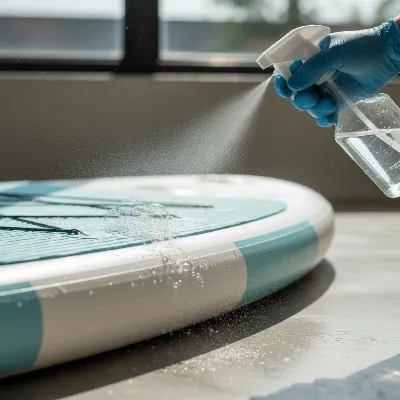 An inflatable paddle board being sprayed with soapy water to reveal air bubbles from a leak.
Submerging the Board
For persistent or extremely slow leaks that are difficult to locate with soapy water, submerging sections of the board in a calm body of water (like a bathtub or a large pool) can be effective. Inflate the board slightly (not necessarily to full PSI) and submerge it section by section, observing closely for any trails of bubbles rising to the surface. This method is particularly useful for pinhole leaks that might not produce prominent bubbles with the spray test.
The 24-48 Hour Pressure Test
If you’ve checked thoroughly and still can’t find an obvious leak, your board might have a very slow, gradual air loss. In this scenario, inflate your board to its full recommended pressure and mark the gauge reading or use tape to indicate the pressure level. Leave the board inflated indoors in a stable temperature environment for 24 to 48 hours. A significant drop in pressure that cannot be attributed to temperature changes indicates a slow leak that likely needs further investigation.
Step-by-Step Guide to Fixing Common Leaks
Once you’ve located the source of the leak, it’s time to apply the appropriate fix. Most inflatable paddle boards come with a repair kit, which typically includes patches, adhesive, and a valve wrench. Ensure you have these items, along with cleaning alcohol or acetone, sandpaper, and a marking pen.
Tightening or Replacing a Leaky Valve
The simplest fix is often for a loose valve. If the soapy water test showed bubbles around the valve base, you likely just need to tighten it.
- Deflate the board completely.
- Locate your valve wrench (often a black or gray plastic tool with a crown-like shape, usually found in your repair kit).
- Insert the wrench into the valve and turn it clockwise, usually a quarter to half turn, while applying gentle downward pressure. Be careful not to overtighten, as this can damage the valve.
- Re-inflate the board and re-test with soapy water. If the bubbles persist, the internal O-rings might be damaged or the valve itself needs replacement. In this case, it’s often best to contact the manufacturer for a compatible replacement valve or seek professional assistance.
Repairing Punctures and Tears
For holes or small tears in the PVC material, a patch kit is your best friend.
- Deflate the board entirely and clean the area around the puncture thoroughly with rubbing alcohol or acetone to remove any dirt, oil, or salt residue. The surface must be completely dry and clean for the adhesive to bond properly.
- Cut a circular patch from the PVC repair material provided in your kit. Ensure the patch is large enough to cover the hole with at least an inch (2-3 cm) of overlap on all sides. Rounding the corners of the patch helps prevent peeling.
- Lightly sand both the area around the hole on the board and the matt side of your patch with fine-grit sandpaper. This creates a slightly rough surface, improving glue adhesion. Wipe away any sanding dust.
- Apply a thin, even layer of PVC glue to both the patch and the prepared area on the board. Crucially, allow the glue to become tacky—usually for 2-5 minutes, depending on the adhesive and environmental conditions. Do not stick it on immediately.
- Carefully place the patch over the hole, pressing firmly from the center outwards to remove any trapped air bubbles. Use the back of a spoon or a roller to apply consistent pressure over the entire patch.
- Place a flat, heavy object (like a book or a small weight) on the patched area for at least 24 hours to ensure a strong, lasting bond. Do not inflate the board during this curing period. After 24 hours, you can re-inflate and test with soapy water to confirm the repair is airtight.
Addressing Damaged Seams
Seam leaks can be trickier, as the surface isn’t always flat.
- Deflate the board fully and meticulously clean the affected seam area with alcohol or acetone, ensuring it’s completely dry.
- For minor seam separations, apply a generous amount of PVC glue directly inside the open seam. Press the layers together firmly.
- Use clamps or heavy weights to hold the seam tightly shut while the glue dries, ideally for 24 hours.
- For added security or larger seam issues, you can apply a patch over the repaired seam after the initial glue has dried, following the puncture repair steps outlined above. Seam repairs, especially significant ones, sometimes benefit from professional repair services if you’re uncertain.
Preventing Future Inflatable Paddle Board Leaks
Proactive care is the best way to keep your inflatable paddle board airtight and extend its lifespan for years of enjoyment.
One of the most critical preventive measures is proper inflation. Always inflate your board to the manufacturer’s recommended PSI, typically found near the valve or in the user manual. Avoid over-inflating, as excessive pressure puts undue stress on seams and materials, potentially leading to damage. Conversely, under-inflation can make the board unstable and prone to damage from bending or flexing.
Careful handling is paramount. Never drag your iSUP across rough surfaces like rocks, concrete, or docks. Always carry it or use a trolley, especially when inflated. Be mindful of sharp objects in the water or on shore, such as oyster beds or broken glass. If you paddle with pets, consider investing in a deck pad protector or nail caps for your dog to prevent accidental punctures.
Proper storage is another key factor in preventing leaks. After each use, rinse your board with fresh water, especially if you’ve been in saltwater, and allow it to dry completely before deflating and storing. UV rays and extreme heat are major enemies of PVC and adhesives. Never leave your inflated board in direct sunlight for prolonged periods, and absolutely avoid storing it in a hot car or garage, as the air inside can expand rapidly, causing catastrophic damage to seams and valves. Store your board in a cool, dry, shaded area, either loosely rolled or lightly inflated to maintain its shape.
Finally, regular inspection can catch small issues before they become major problems. A quick visual check of the valve, seams, and main body of the board after each use can help identify wear, minor abrasions, or potential weaknesses.
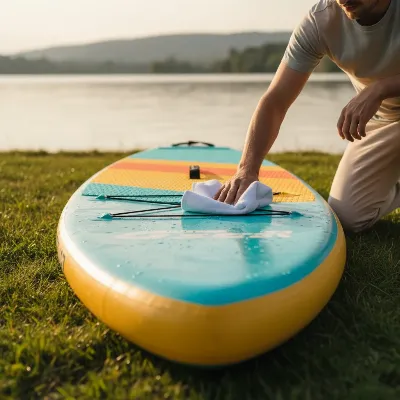 A person carefully cleaning an inflatable paddle board after use, demonstrating proper maintenance for longevity.
Top Tips for Inflatable SUP Longevity
Ensuring the longevity of your inflatable stand-up paddle board goes beyond just fixing leaks; it involves a holistic approach to care and use. Investing in a board made from quality materials, such as military-grade PVC with fused layers, can significantly increase its resistance to punctures and seam degradation. These materials are designed to withstand harsher conditions and offer greater durability over time.
Understanding the environmental impacts on your iSUP is also crucial. Saltwater and prolonged exposure to UV radiation can degrade the board’s materials and adhesives. Therefore, thorough rinsing after saltwater use and minimizing direct sun exposure, especially during storage, will help preserve the board’s integrity.
Gentle transport practices are equally important. When moving your inflated board, ensure sufficient clearance from the ground to avoid scuffs or rips. When deflated and rolled, avoid dragging it, as this can create friction points that lead to wear and potential leaks. Always use a proper carry bag or shoulder strap.
Maintaining and Cleaning Your Paddle Board
Consistent maintenance and cleaning are simple yet effective ways to prevent leaks and extend the life of your inflatable paddle board. After every paddle session, particularly if you’ve been in saltwater or murky conditions, it’s vital to rinse your board thoroughly with fresh water. This removes salt, sand, and other debris that can abrade the material or clog the valve over time.
After rinsing, ensure the board is completely dry before deflating and storing. Moisture trapped during storage can lead to mold and mildew, which can degrade the PVC material and adhesives. You can wipe it down with a clean towel and allow it to air dry in a shaded spot.
For storage, consider whether to store your board fully deflated and rolled, or lightly inflated. If storing deflated, make sure it’s rolled loosely to prevent creasing that could weaken the material over time. Some experts recommend storing it lightly inflated (around 5-7 PSI) if space allows, as this avoids tight folds and helps the material maintain its shape. Whichever method you choose, always store it in a cool, dry, and shaded environment, away from extreme temperatures and direct sunlight.
Conclusion
Discovering an air leak in your inflatable paddle board can be disheartening, but with the right knowledge and tools, it’s a manageable problem. From identifying common causes like loose valves, punctures, and seam damage to employing effective detection methods like the soapy water test, you’re now equipped to diagnose and address most issues. By following the step-by-step repair guides for valves, punctures, and seams, and by adopting preventive measures such as proper inflation, careful handling, and vigilant maintenance, you can ensure your inflatable paddle board remains in excellent condition. Don’t let a small leak keep you from the water; instead, empower yourself to become your own iSUP expert. What exhilarating adventure will you embark on next, now that your board is ready for the water?
Câu Hỏi Thường Gặp
How quickly should an inflatable paddle board lose air?
It’s normal for an inflatable paddle board to lose a slight amount of air due to temperature changes or micro-permeation, typically a few PSI over 24-48 hours. Rapid or significant air loss (more than 5 PSI in a day) usually indicates a leak that needs attention.
Can I use super glue to fix an inflatable paddle board?
No, super glue (cyanoacrylate adhesive) is not recommended for inflatable paddle board repairs. It dries rigidly and can crack or fail when the board flexes or is rolled, potentially making the leak worse. Always use a specialized PVC adhesive designed for inflatables, usually found in your board’s repair kit.
Is it safe to paddle with a slow leak?
Paddling with a slow leak is generally not recommended as it compromises the board’s structural integrity, stability, and performance. A slow leak can also quickly worsen, leaving you stranded on the water. It’s always best to repair any leak, no matter how small, before heading out.
How often should I check my paddle board for leaks?
It’s a good practice to perform a quick visual inspection of your inflatable paddle board before and after each use. A more thorough leak check using soapy water should be done at least once a season or whenever you notice unusual air loss.
Can cold weather cause my paddle board to lose air?
Yes, cold weather can cause your inflatable paddle board to lose air pressure. Air contracts in colder temperatures, leading to a temporary drop in PSI. This is normal and not indicative of a leak. Your board will regain pressure as temperatures rise.
