Imagine a perfect summer day: the sun is shining, the water is calm, and your inflatable paddle board (iSUP) is ready for adventure. You step off for a quick break, leaving your board basking on the shore. But have you ever wondered what those intense rays are doing to your beloved iSUP? While inflatable paddle boards offer unparalleled portability and convenience, their material composition makes them particularly vulnerable to the harsh effects of direct sunlight and extreme heat. Understanding these risks and implementing proper care practices is crucial for extending the life of your board and ensuring many more joyful days on the water. This article will delve into why the sun poses such a threat and, more importantly, how you can effectively protect your investment.
The Perils of Sun Exposure for Inflatable Paddle Boards
Leaving your inflatable paddle board exposed to direct sunlight for extended periods can lead to several significant and often irreversible forms of damage. The primary culprits are heat expansion and ultraviolet (UV) radiation, both of which can compromise the integrity and lifespan of your iSUP.
Over-Pressurization and Seam Strain
|
Our Picks for the Best Paddle Board in 2026
As an Amazon Associate I earn from qualifying purchases.
|
||
| Num | Product | Action |
|---|---|---|
| 1 | FunWater Inflatable Stand Up Paddle Board with Premium SUP Paddleboard Accessories, Anti-Slip EVA Deck, 11'/10'6'' Paddle Boards for Adults & Youth of All Skill Levels |

|
| 2 | Roc Inflatable Stand Up Paddle Board 10' 6" with Premium SUP Paddle Board Accessories, Wide Stable Design, Non-Slip Comfort Deck for Youth & Adults |
|
| 3 | FunWater Inflatable Stand Up Paddle Board with Premium SUP Paddleboard Accessories, Anti-Slip EVA Deck, 11'/10'6'' Paddle Boards for Adults & Youth of All Skill Levels |
|
| 4 | Roc Inflatable Stand Up Paddle Board 10' 6" with Premium SUP Paddle Board Accessories, Wide Stable Design, Non-Slip Comfort Deck for Youth & Adults |
|
| 5 | Retrospec June Nano Kids Inflatable Fishing Paddle Board SUP Kayak: 9'6" Hybrid Paddleboard with Rod Holders, Removable Seat - Lightweight Portable Youth Fishing Board |
|
| 6 | Roc Inflatable Stand Up Paddle Board 10' 6" with Premium SUP Paddle Board Accessories, Wide Stable Design, Non-Slip Comfort Deck for Youth & Adults |
|
| 7 | FBSPORT 11' Premium Stand Up Paddle Board, Yoga Board with SUP Accessories & Carry Bag | Wide Stance, Surf Control, Non-Slip Deck, Leash, Paddle and Pump for Youth & Adult |
|
| 8 | Roc Inflatable Stand Up Paddle Boards with Premium SUP Paddle Board Accessories, Wide Stable Design, Non-Slip Comfort Deck for Youth & Adults |
|
| 9 | Niphean Inflatable Stand Up Paddle Board with SUP Accessories, Anti-Slip EVA Deck, 10’6’’ Inflatable Paddle Boards for Adults & Youth of All Skill Levels |
|
| 10 | Highpi Inflatable Stand Up Paddle Board for Youth and Adults – Wide Sup with Premium Accessories, Blow Up Paddleboard for Surfing, Fishing, Yoga & More |
|
One of the most immediate and dangerous effects of sun exposure on an inflated paddle board is the rapid increase in internal air pressure. As the ambient temperature rises, the air inside your board expands. Since the board is a sealed environment, this expansion has nowhere to go but to increase pressure against the board’s internal structure and seams. If already inflated to its recommended PSI, the added pressure from the sun can push it beyond safe limits, straining the drop-stitch threads and, critically, the welded or glued seams. This can lead to the infamous “banana” shape, where the board warps, or in severe cases, cause seams to burst, rendering the board unusable. Darker colored boards are particularly susceptible as they absorb more heat, accelerating this process.
UV Degradation and Material Weakening
Just as prolonged sun exposure can damage your skin, ultraviolet (UV) rays are detrimental to the PVC material of your inflatable paddle board. Over time, UV radiation breaks down the chemical bonds within the PVC, causing the material to degrade, weaken, and become brittle. You might notice the colors of your board fading, its surface losing its original sheen, or the deck pad cracking and peeling. This degradation accelerates the aging process of the board, reducing its overall robustness, elasticity, and resistance to punctures and abrasions. Even if a board features UV-resistant coatings, these protective layers can diminish over time with consistent exposure.
Adhesive Failure and Delamination
Many components of an inflatable paddle board, such as the outer PVC layers, D-rings, and valve patches, are held together or attached using strong adhesives. Extreme heat from direct sunlight can soften these glues and bonding points. When adhesives soften, they lose their structural integrity, making them prone to peeling or separating. This can lead to critical failures like delamination, where layers of the board separate, or accessories detaching unexpectedly. The traction pad, often glued to the deck, is also at risk of peeling off, impacting both performance and comfort.
The Danger of Hot, Enclosed Spaces
While leaving an iSUP on a sunny beach is risky, storing it in a hot, enclosed space like a car trunk, rooftop cargo box, or a tightly sealed shed can be even more hazardous. These spaces can trap and amplify heat to extreme levels, causing the air inside your board to expand at an alarming rate. Temperatures inside a parked car on a hot day can soar, quickly turning your vehicle into a pressure cooker for your paddle board. This intense and rapid heat buildup significantly increases the risk of catastrophic seam failure or even a board bursting. It is a common mistake that can lead to irreparable damage.
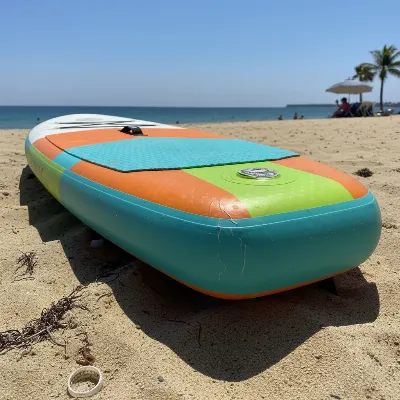 Inflatable paddle board left on a beach under intense sun, showing signs of heat stress.
Understanding Inflatable Paddle Boards
Before diving deeper into protection strategies, it helps to understand what an inflatable paddle board is and how its construction makes it unique, particularly regarding sun and heat vulnerability.
What is an Inflatable Paddle Board?
An inflatable paddle board, or iSUP, is a type of stand-up paddle board designed for portability and easy storage. Unlike traditional rigid boards, iSUPs can be deflated, rolled up, and packed into a backpack-style bag, making them ideal for travel and those with limited storage space. When inflated, they become incredibly rigid and stable, offering a paddling experience comparable to hard boards.
Materials and Construction
The core of an iSUP’s rigidity comes from “drop-stitch” technology. Thousands of tiny polyester threads connect the top and bottom layers of PVC fabric. When inflated, these threads pull taut, creating a flat, stiff surface. The outer shell is typically made from multiple layers of military-grade PVC (polyvinyl chloride), often reinforced with additional fabric layers, making them surprisingly durable against punctures and abrasions. Many modern iSUPs also incorporate UV-resistant coatings or treatments in their PVC to offer some protection against sun damage. However, these coatings are not invincible and prolonged exposure will still lead to degradation. The flexibility of PVC and the nature of air expansion are precisely what make iSUPs susceptible to heat and UV damage.
Hard Boards for Contrast
While this article focuses on iSUPs, it’s worth noting that rigid (hard) paddle boards, typically made from EPS foam cores with fiberglass or epoxy shells, also face sun-related issues. Excessive heat can cause delamination in hard boards, where the outer shell separates from the foam core, leading to bubbles and structural weakness. While they don’t have the same internal pressure concerns as inflatables, UV rays can still degrade their resin and cause fading. This highlights that sun protection is a universal concern for all paddle boarders.
Essential Strategies to Protect Your SUP from the Sun
Protecting your inflatable paddle board from the sun’s harmful effects is straightforward and requires consistent effort. Incorporating these simple habits into your paddle boarding routine will significantly extend your board’s lifespan.
Seek Shade Immediately
The golden rule for iSUP longevity is to keep it out of direct sunlight whenever you’re not actively paddling on the water. Water acts as a cooling agent, dissipating heat and mitigating pressure buildup. However, the moment your board comes ashore, it begins to heat up rapidly.
> “Always remember, when your board is out of the water, it should be out of the sun.” – Sarah Jenkins, Professional SUP Instructor
When taking a break on the beach, under a tree, or by a tent, ensure your board is in a shaded area. If shade is unavailable, consider flipping your board over to protect the deck pad, or better yet, cover it with a towel, tarp, or a specialized board cover to block the sun’s rays.
Regulate Internal Pressure (Slight Deflation)
Temperature fluctuations directly impact the internal pressure of your iSUP. If you plan to leave your inflated board on land for an extended period, especially on a hot day, it’s highly advisable to release a small amount of air from the valve. Dropping the PSI by 2-5 pounds (e.g., from 15 PSI to 10-12 PSI) provides crucial room for the air to expand without over-stressing the seams. This simple action can prevent warping and catastrophic seam failure. When you’re ready to hit the water again, a few quick pumps will bring it back to optimal pressure.
Utilize Protective Gear (Covers and Bags)
Investing in a high-quality UV-resistant board cover or a padded board bag is an excellent way to safeguard your iSUP. These covers act like sunscreen for your board, reflecting harmful UV rays and keeping the surface temperature significantly cooler. Some covers are designed to create an air gap, further enhancing insulation. For short-term storage or transport, a protective cover is invaluable. For long-term storage, even indoors, keeping your board in its original bag or a dedicated storage bag will provide an extra layer of protection against dust, accidental damage, and residual UV light from windows.
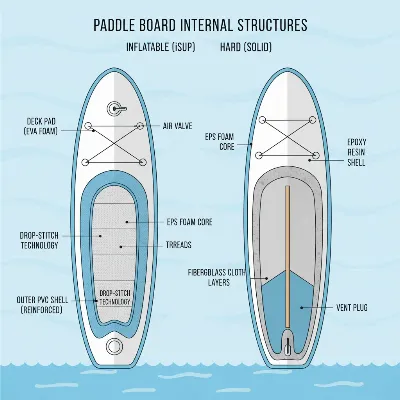 Cross-section illustration comparing inflatable and hard paddle boards.
Store Smartly for Long-Term Health
When storing your iSUP for an extended period, such as over the off-season, proper storage is paramount. Deflate the board completely, ensuring it’s clean and thoroughly dry to prevent mold or mildew. Store it in a cool, dry place away from direct sunlight and extreme temperature fluctuations. Garages, basements, or climate-controlled indoor spaces are ideal. Avoid attics, conservatories, or unventilated sheds that can become extremely hot. Rolling the board loosely rather than tightly can also reduce stress on the material and seams.
Proper Inflation for Hot Conditions
When inflating your board on a particularly hot day or in direct sunlight, be mindful of the temperature. It’s often wise to inflate it slightly below the manufacturer’s recommended maximum PSI, especially if you plan to move it from a cooler spot to direct sun, or if the board will be sitting on hot sand before entering the water. The heat will naturally cause the internal pressure to rise. Starting a little under the maximum ensures you have a safety buffer against over-pressurization. Conversely, when using your board directly on the water, you can typically inflate to the recommended PSI, as the water will help regulate its temperature.
A Comparison: Inflatable vs. Hard SUPs and Sun Vulnerability
While both inflatable and hard paddle boards are susceptible to sun damage, the nature of the damage and the primary risks differ due to their construction. Understanding these differences can help you tailor your protection strategies.
| Feature | Inflatable Paddle Boards (iSUPs) | Hard Paddle Boards (Solid SUPs) |
|---|---|---|
| Primary Material | Multi-layer PVC, drop-stitch core | EPS foam core, fiberglass/epoxy shell |
| Main Sun Risk | Over-pressurization, seam failure, PVC degradation | Delamination of outer shell, epoxy softening/cracking |
| Heat Expansion | High (air expands rapidly, increasing internal pressure) | Moderate (materials expand, but no internal air pressure issue) |
| UV Damage Impact | PVC weakening, fading, deck pad cracking, adhesive failure | Resin degradation, fading, surface cracking |
| Immediate Damage | Burst seams, warping | Bubbles, structural weakness, delamination |
| Storage in Sun (Short-term) | Avoid completely; deflate partially if necessary in shade | Keep in shade or cover; can warp if left on uneven hot surface |
| Storage in Hot Car | Extremely dangerous (risk of bursting) | Very risky (delamination, warping) |
| Protective Measures | Shade, partial deflation, UV covers, cool storage | Shade, board bags/covers, avoiding uneven hot surfaces |
This comparison highlights that while both board types require sun protection, the internal pressure dynamics of inflatable boards present a unique and potentially more immediate risk of catastrophic failure in direct sunlight.
Choosing and Caring for Your Paddle Board
The longevity of your paddle board starts with your purchasing decision and continues with diligent maintenance.
Factors to Consider When Buying
When investing in a paddle board, especially if you plan to use it in sunny climates, consider these factors:
- Material Quality: Look for iSUPs made with high-grade, multi-layer PVC and robust drop-stitch construction. Higher quality materials often have better inherent resistance to environmental stressors.
- UV Protection Coatings: Inquire about or look for boards that explicitly mention UV-resistant coatings or treatments. While not a complete shield, they offer an important first line of defense.
- Color: Lighter-colored boards tend to absorb less heat than darker ones, potentially reducing the rate of internal temperature increase. This can be a minor but helpful consideration in very hot, sunny regions.
- Manufacturer Reputation: Choose reputable brands known for durability and good customer service, as they often use better materials and construction techniques.
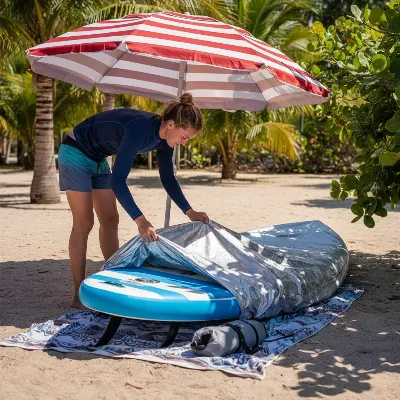 Person covering an inflatable paddle board with a UV cover in a shaded spot.
Routine Maintenance for Longevity
Beyond sun protection, consistent general maintenance will significantly prolong your paddle board’s life.
- Clean After Every Use: Always rinse your board thoroughly with fresh water after each session, especially if you’ve been in saltwater or sandy environments. Salt and sand, when dried and baked on by the sun, can be abrasive and cause premature wear to the deck pad and PVC.
- Dry Completely Before Storage: Ensure your board is completely dry before deflating and rolling it for storage. Moisture trapped inside or on the surface can lead to mold, mildew, and material degradation over time.
- Inspect Regularly: Periodically check your board for any signs of wear and tear, such as small leaks, weakened seams, or cracking in the PVC or deck pad. Addressing minor issues promptly can prevent them from escalating into major repairs.
- Proper Inflation (Not Just for Heat): Always inflate your board to the manufacturer’s recommended PSI for optimal performance and structural integrity. Over-inflation at any temperature can stress the materials, and under-inflation can make the board unstable and prone to bending, which can also strain seams.
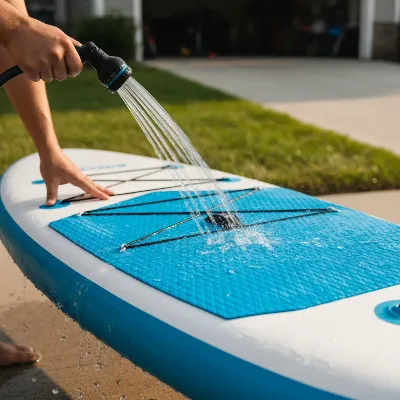 Person rinsing an inflatable paddle board with fresh water after a session.
Conclusion
The question of whether you can leave an inflatable paddle board in the sun has a clear answer: it’s highly advisable to avoid prolonged exposure. The sun’s intense heat and relentless UV rays pose significant threats, from dangerous over-pressurization and seam failure to material degradation and aesthetic damage. By understanding these risks and diligently implementing preventative measures—seeking shade, managing internal pressure, using protective covers, and storing your board appropriately—you can safeguard your iSUP and ensure its enduring performance. A little care goes a long way in preserving your board’s integrity, allowing you to focus on the joy and adventure of paddle boarding for many seasons to come. What adventures will you embark on next, now that you’re equipped with the knowledge to protect your paddle board?
Frequently Asked Questions
How hot is too hot for an inflatable paddle board?
While there isn’t a single definitive temperature, most manufacturers advise against prolonged exposure to temperatures above 100°F (38°C), especially when inflated. Enclosed spaces like cars can easily exceed this, making them particularly dangerous. The key risk comes from the combination of high temperatures causing air expansion and direct sunlight intensifying the heat.
Can I leave my inflatable SUP inflated in the garage?
You can generally leave your inflatable SUP inflated in a garage, provided the garage remains cool, dry, and out of direct sunlight. Garages that heat up significantly in summer, or have windows allowing direct sun exposure, are not ideal. It’s often recommended to slightly reduce the PSI (to 10-12 PSI) if storing inflated for an extended period to relieve pressure on the seams.
What is UV degradation on a paddle board?
UV degradation refers to the damage caused by ultraviolet radiation from the sun breaking down the molecular structure of the PVC material used in inflatable paddle boards. This process leads to fading colors, loss of material elasticity, increased brittleness, and eventual cracking or peeling of the board’s surface and deck pad, shortening its lifespan.
Are darker colored paddle boards more susceptible to sun damage?
Yes, darker colored paddle boards are generally more susceptible to heat-related damage from the sun. Darker colors absorb more solar radiation than lighter colors, leading to a higher internal temperature and a faster increase in air pressure within an inflatable board. This accelerates the risks of over-pressurization and seam failure.
How often should I apply UV protectant to my paddle board?
While many modern boards come with inherent UV protection, you can enhance it with aftermarket UV protectant sprays. The frequency of application depends on the product and your board’s exposure, but typically, applying a marine-grade UV protectant every few months, or before extended periods of intense sun exposure, can offer an added layer of defense. Always ensure the board is clean and dry before application.
