Summer camps offer incredible opportunities for children to explore new activities, build confidence, and create lasting memories. For many, that adventure extends to the water, where stand-up paddleboarding (SUP) has become a beloved pursuit. As the Admin of ReviewInsides.com, with over a decade immersed in the world of paddleboarding, I’ve seen firsthand how a properly chosen board can transform a child’s experience from frustrating to fantastic. This guide is crafted from years of hands-on experience and deep dives into the latest gear, ensuring you can confidently select the perfect paddle board for your young adventurer, ready for a summer of fun in 2026 and beyond.
What is a Kids Paddle Board?
A kids paddle board is specifically designed to meet the unique needs of younger, lighter paddlers. Unlike adult boards, which often prioritize speed or carrying capacity for larger individuals, children’s SUPs focus on stability, maneuverability, and ease of handling. The goal is to provide a platform that allows kids to feel confident and in control, making learning and exploring the water an enjoyable experience rather than a struggle with an oversized board. These boards are typically shorter, narrower, and thinner than their adult counterparts, making them significantly lighter and easier for small hands to carry and manage.
Popular Types of Paddle Boards for Young Paddlers
Understanding the different types of paddle boards available is the first step in making an informed choice for your child. Each type offers distinct advantages, catering to various skill levels and intended uses, from calm lake paddling to adventurous surfing.
Inflatable Paddle Boards (iSUPs)
Inflatable Stand-Up Paddleboards (iSUPs) are overwhelmingly popular for children, and for good reason. They are constructed from durable PVC layers with drop-stitch technology, allowing them to be inflated to a rigid form and then deflated for easy storage and transport.
- Advantages: Their lightweight nature makes them simple for kids to carry to and from the water. They are also incredibly durable and forgiving; if a child falls on an iSUP or bumps it against an obstacle, the impact is less severe than with a hard board. Portability is a huge plus for summer camps or family trips, as they pack down into a backpack.
- Disadvantages: While modern iSUPs are remarkably stiff, they generally don’t offer the same level of rigidity and performance as a high-end hard board, which might be a consideration for very advanced young paddlers looking for speed.
- Best Use Cases: iSUPs are ideal for recreational paddling on lakes, calm rivers, and protected bays, making them perfect for the diverse environments often found at summer camps. They are also great for paddleboard yoga for kids or simply floating and playing.
|
Our Picks for the Best Paddle Board in 2026
As an Amazon Associate I earn from qualifying purchases.
|
||
| Num | Product | Action |
|---|---|---|
| 1 | Roc Inflatable Stand Up Paddle Boards with Premium SUP Paddle Board Accessories, Wide Stable Design, Non-Slip Comfort Deck for Youth & Adults |

|
| 2 | Retrospec June Nano Kids Inflatable Fishing Paddle Board SUP Kayak: 9'6" Hybrid Paddleboard with Rod Holders, Removable Seat - Lightweight Portable Youth Fishing Board |
|
| 3 | Roc Inflatable Stand Up Paddle Board 10' 6" with Premium SUP Paddle Board Accessories, Wide Stable Design, Non-Slip Comfort Deck for Youth & Adults |
|
| 4 | FunWater Inflatable Stand Up Paddle Board with Premium SUP Paddleboard Accessories, Anti-Slip EVA Deck, 11'/10'6'' Paddle Boards for Adults & Youth of All Skill Levels |
|
| 5 | Roc Inflatable Stand Up Paddle Board 10' 6" with Premium SUP Paddle Board Accessories, Wide Stable Design, Non-Slip Comfort Deck for Youth & Adults |
|
| 6 | Highpi Inflatable Stand Up Paddle Board for Youth and Adults – Wide Sup with Premium Accessories, Blow Up Paddleboard for Surfing, Fishing, Yoga & More |
|
| 7 | Roc Inflatable Stand Up Paddle Board 10' 6" with Premium SUP Paddle Board Accessories, Wide Stable Design, Non-Slip Comfort Deck for Youth & Adults |
|
| 8 | Niphean Inflatable Stand Up Paddle Board with SUP Accessories, Anti-Slip EVA Deck, 10’6’’ Inflatable Paddle Boards for Adults & Youth of All Skill Levels |
|
| 9 | FBSPORT 11' Premium Stand Up Paddle Board, Yoga Board with SUP Accessories & Carry Bag | Wide Stance, Surf Control, Non-Slip Deck, Leash, Paddle and Pump for Youth & Adult |
|
| 10 | FunWater Inflatable Stand Up Paddle Board with Premium SUP Paddleboard Accessories, Anti-Slip EVA Deck, 11'/10'6'' Paddle Boards for Adults & Youth of All Skill Levels |
|
Hard Paddle Boards (Solid SUPs)
Hard paddle boards are constructed from materials like fiberglass, epoxy, or carbon fiber, offering superior rigidity and performance. While less common for children’s specific models, some smaller hard boards can be suitable for more experienced young paddlers.
- Advantages: They excel in stability, speed, and tracking (maintaining a straight line). For kids interested in racing or surfing, a hard board can offer a more responsive and high-performance ride.
- Disadvantages: Hard boards are much heavier and more cumbersome to transport and store. They are also less forgiving on impact, both for the paddler and the board itself, meaning dings and damage are more likely.
- Best Use Cases: Primarily for competitive racing or surfing where performance is paramount. For the average summer camp setting, an iSUP usually offers more practical benefits.
All-Around Kids SUPs
Most paddle boards marketed for children fall into the “all-around” category. These boards are designed to be versatile, offering a good balance of stability, maneuverability, and ease of use across various water conditions. They are typically iSUPs, providing the best blend of features for young beginners and recreational paddlers.
Touring and Surf Kids SUPs
While specialized kids’ touring or surf SUPs exist, they are less common for general camp use.
- Touring SUPs for kids would be longer and narrower, designed for efficiency over distance.
- Surf SUPs are shorter and highly maneuverable for catching waves. These are usually for more experienced young paddlers or those with a specific interest in a particular discipline.
Choosing the Right Paddle Board for Your Child
Selecting the ideal paddle board involves more than just picking a fun color. Several crucial factors should guide your decision to ensure your child has a safe, enjoyable, and confidence-building experience on the water.
When considering a paddle board, first think about its purpose. Will your child use it for casual cruising, trying out paddleboard yoga, exploring calm waterways, or perhaps even catching small waves? This will influence the board’s shape and features. The child’s age, weight, and height are paramount; a board too large will be difficult to handle, while one too small might lack stability. Skill level also plays a role. Beginners benefit from wider, more stable boards, while more experienced kids might appreciate something more agile. Your budget will naturally dictate options, but remember that investing in a quality, durable board can often save money in the long run. Lastly, consider the board’s “growability.” Some models are designed to accommodate a child as they grow, offering longevity.
Specifically, for children, look for boards between 7.5 to 9 feet in length, 27 to 30 inches in width, and 4 to 5 inches in thickness. A thinner board sits lower in the water, improving stability and making it easier for a child to climb back on after a fall. For materials, high-density PVC with fused drop-stitch construction is excellent for durability in iSUPs. A flexible, permanent fin setup is often best for kids, as they are less likely to get lost or broken than removable ones.
Essential accessories complete the package. A lightweight, adjustable paddle is critical so it can be sized correctly to your child’s height (8-12 inches taller than them). A safety leash is non-negotiable, keeping the board tethered to the paddler. For younger or less confident swimmers, a personal flotation device (PFD) or life jacket is a must. For iSUPs, a reliable pump (often dual-action) and a backpack for transport are essential. Don’t forget a dry bag for essentials like snacks and sunscreen!
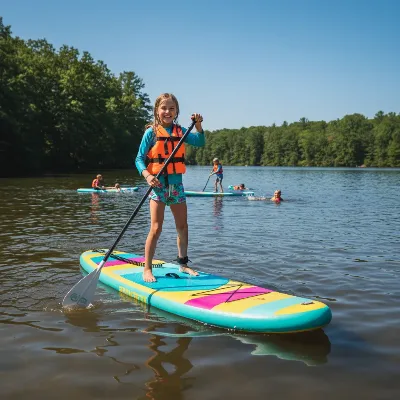 Young girl happily paddleboarding on a lake at summer camp with other children in the background.
Comparing Kids Paddle Board Types
To help you visualize the differences, here’s a comparison of common kids’ paddle board types:
| Feature | Inflatable (iSUP) for Kids | Hard Board (Solid SUP) for Kids (Smaller models) | All-Around Kids SUP (Often iSUP) |
|---|---|---|---|
| Stability | Excellent (especially wider models) | Good to Excellent (can be less forgiving for falls) | Excellent (designed for balance) |
| Speed | Moderate | Good to Excellent (more rigid for glide) | Moderate |
| Portability | Excellent (packs into backpack) | Poor (heavy, bulky, requires car rack) | Excellent (if inflatable) |
| Price | Mid-range | Higher | Mid-range |
| Durability | Very good (resistant to dings/impacts) | Good (but prone to dings/scratches on impact) | Very good (if inflatable, built for active use) |
| Best Use | Recreational, yoga, general camp, travel, calm water | Surfing (for experienced), racing (for experienced), performance | General paddling, learning, versatility across conditions |
| User Experience | Forgiving, easy to learn, comfortable falls | Responsive, faster, less forgiving for falls | Easy, confidence-building, versatile |
Top Kids Paddle Boards for Summer Camp 2026
Based on their features, durability, ease of use, and suitability for a summer camp environment, here are some of the top kids’ paddle boards that shine in 2026.
-
Thurso Surf Prodigy Jr.:
- Pros: This 7’6″ board is a fantastic choice for younger or smaller paddlers. It’s built with the same quality materials as Thurso’s adult lines, ensuring rigidity and durability. Its shorter length makes it highly maneuverable, and the 4″ thickness keeps kids low to the water for excellent stability. It often comes as a complete package, including a kid-sized paddle and pump.
- Cons: Best suited for lighter children; older or heavier kids might outgrow it quickly.
- Ideal for: Little ones and first-time paddlers.
-
Retrospec Weekender Nano Kids’ Inflatable SUP:
- Pros: At 8′ long and only 12.2 lbs, the Nano is incredibly lightweight, making it easy for kids to carry on their own. It offers great stability with a wider body and rounded hull. It’s often available at a more budget-friendly price point, making it an appealing option for parents. Made with durable PVC, it’s built to withstand youthful energy.
- Cons: While stable, its emphasis is on portability and ease of use rather than high performance.
- Ideal for: Younger kids, budget-conscious families, and those prioritizing lightweight transport.
-
Honu Airlie 8’6” iSUP:
- Pros: For the more serious junior paddler or those ready to advance their skills, the Honu Airlie (8’6″ x 27″ x 4.7″) offers a higher-performance experience. It’s still lightweight (around 11.9 lbs) but designed to allow kids to hone their form with a slightly narrower profile, improving glide and tracking. Honu is known for its excellent construction quality.
- Cons: Its slightly narrower design might be a bit more challenging for absolute beginners, requiring a bit more balance.
- Ideal for: Intermediate young paddlers, those seeking better performance, and kids who will grow with their board.
-
BOTE FlowRider Aero 8′:
- Pros: This innovative board offers fantastic versatility as a full-hybrid iSUP that can convert into an inflatable kayak with an included seat and convertible paddle. The extra-large fin enhances straight-line tracking, a huge benefit for kids. It’s built tough and provides a stable platform for various water activities beyond just paddleboarding.
- Cons: The hybrid features might add a slight premium to the price.
- Ideal for: Kids who want versatility, enjoy exploring, and might also be interested in kayaking.
-
Red Paddle Co Snapper (9’4″ All-Round SUP):
- Pros: Red Paddle Co is renowned for its premium quality, and the Snapper for kids is no exception. It’s double-laminated and built to withstand significant wear and tear, making it incredibly durable. It’s an excellent all-around board that offers superb stability and comes as a complete, high-quality package, including a robust bag with wheels, an alloy paddle, a leash, and a pump.
- Cons: This is a premium-priced option compared to some other kids’ boards.
- Ideal for: Families looking for a top-tier, long-lasting board that can handle years of use and potentially multiple children.
Care and Maintenance for Your Kids Paddle Board
Proper care ensures your child’s paddle board remains in excellent condition for many summers to come. A little attention after each use can significantly extend its lifespan and maintain its performance.
After each adventure, make sure to thoroughly rinse the paddle board with fresh water to remove any salt, sand, or debris. Use a mild soap and a soft brush for tougher spots, then allow it to air dry completely out of direct sunlight before storing. For inflatable boards, ensure they are fully dry before deflating and rolling them up to prevent mildew. Store iSUPs in their bag in a cool, dry place, away from extreme temperatures and pests. Hard boards should be stored on racks or padded surfaces to avoid damage and covered to protect them from UV rays. Always inspect the board for any small punctures or damage before each use, especially with inflatables, to ensure safety and prevent major issues. Remember to check the paddle for any cracks or loose parts, and rinse the leash as well.
Conclusion
Choosing the right paddle board for your child is an investment in their outdoor enjoyment and physical development. By prioritizing factors like size, stability, durability, and safety features, you can ensure they have a board that fits their needs perfectly, fostering confidence and a lifelong love for water sports. Whether it’s the portable convenience of an iSUP for varied camp activities or a performance-oriented board for more experienced young paddlers, the market offers fantastic options for every aspiring adventurer. Equip them well, and watch them thrive on the water!
What adventures do you envision for your child on their very own paddle board this summer?
Frequently Asked Questions
How old should a child be to paddle board independently?
Most children can start learning to paddle board independently around 4 to 6 years old, provided they are comfortable in the water and can swim. However, a child’s readiness depends more on their confidence, balance, and coordination than a strict age. Younger children often start by riding on a parent’s board before transitioning to their own.
Do kids need a PFD (Personal Flotation Device) when paddle boarding?
Yes, absolutely. A PFD or life jacket is an essential safety accessory for all children, regardless of their swimming ability. It provides crucial buoyancy and peace of mind for parents, ensuring they stay safe if they fall into the water. Always check local regulations, as PFDs are often legally required for minors on the water.
What is the correct paddle size for a child?
A child’s paddle should typically be 8 to 12 inches taller than their height. This allows them to paddle efficiently without straining. Look for adjustable paddles, which are ideal for growing children and can be shared among different-sized users. The paddle blade itself should also be smaller than an adult’s to accommodate less strength.
Can an adult use a kids’ paddle board?
Generally, no. Kids’ paddle boards are specifically designed for lighter body weights and have lower volume, which means they often cannot adequately support an adult. An adult using a child’s board would find it unstable and likely submerge it, making it difficult to paddle effectively. However, some larger “kids” boards, often marketed for teens, might be suitable for very lightweight adults.
